



Arizona Exterior Painting Guide
Sun-Proofing Your Home: How Extreme Arizona UV Breaks Down Exterior Paint
Learn what relentless East Valley sun exposure does to exterior paint, how to recognize coating failure, and what helps a paint system survive Arizona heat, dust, and monsoon weather.
If your house looked freshly painted three summers ago and now looks tired, faded, and slightly powdery, nothing necessarily went wrong with the paint. It did exactly what paint does in Mesa.
The East Valley sits under one of the most punishing ultraviolet loads in North America. Phoenix-area homes get roughly 300 sunny days a year, summer surface temperatures on a west-facing stucco wall can climb well past the air temperature, and there is very little cloud cover or humidity to soften the exposure. Paint that would comfortably last a decade in Ohio can start visibly failing here in four or five years.
This guide explains what UV actually does to an exterior paint film, how to read the warning signs on your own walls, how often Arizona homes realistically need repainting, and what separates a coating system that survives out here from one that does not.
Understanding Coating Failure
What UV Radiation Actually Does to Paint
Exterior paint is not one material. It is a system of three things working together: pigment for color and opacity, a resin binder that holds everything into a continuous flexible film, and additives that manage flow, mildew resistance, and UV absorption.
Ultraviolet light attacks the binder first. UV photons carry enough energy to break the chemical bonds in the resin, a process called photodegradation. As those bonds break, the film loses cohesion and flexibility. The pigment that the binder was holding in place starts to release, which is why a sun-beaten wall leaves chalky residue on your hand.
UV Weakens the Binder
Sunlight breaks down the resin that holds the coating together, gradually reducing adhesion and flexibility.
Heat Flexes the Film
Daily temperature swings repeatedly expand and contract the coating until weakened paint begins to crack.
Weather Enters the Gaps
Dust abrades the surface, and monsoon rain penetrates the openings created by UV and thermal movement.
Thermal Cycling
A wall can swing from a cool early morning to a scorching afternoon surface temperature and back again, every single day. The paint film expands and contracts through that swing. A binder already weakened by UV cannot keep flexing, so it cracks.
Dust and Monsoon Abrasion
Blowing dust in the pre-monsoon and haboob season sandblasts the surface at a microscopic level, stripping away the already fragile outer layer and exposing fresh film to more UV.
The Stacked Failure Effect
UV weakens the coating, heat repeatedly flexes it, blowing dust abrades it, and monsoon rain then finds every crack the first three created.
Sun Exposure by Elevation
The Orientation Problem Every Mesa Homeowner Should Know
Walk around your house and you will almost always find that the paint has failed unevenly. That is not necessarily a workmanship issue. It is solar orientation.
This is why spot-touching a single wall rarely looks right. The touched-up section is fresh pigment against years of faded pigment. On homes in Gilbert, Queen Creek, and east Mesa where lots are open and there is little mature shade, the contrast can be dramatic.
Exterior Paint Inspection
How to Read Paint Failure on Your Own Walls
Before you call anyone, you can diagnose many common coating problems yourself. Run your hand across a west-facing wall and look at the surface in raking morning light. Here is what each symptom can mean.
| Failure Type | What You See | What Caused It | What It Means |
|---|---|---|---|
| Chalking | Powdery residue on your hand after touching the wall. | UV has broken down the resin binder, releasing loose pigment. | Surface-level UV wear. Often still repaintable after a thorough wash. |
| Fading | Color noticeably lighter on south and west walls. | UV is destroying or changing pigment molecules. | Cosmetic at first, but usually a sign the binder is degrading too. |
| Blistering | Bubbles under the paint film. | Moisture or solvent trapped under a film applied in extreme heat. | Often application-related and usually requires scraping and spot priming. |
| Cracking and Alligatoring | A web of fine cracks across the surface. | The film has lost flexibility and cannot move with the stucco. | A potential water entry point that should be addressed before the next monsoon. |
| Peeling and Delamination | Sheets of paint lifting away from the stucco. | Bond failure, often over an old incompatible or unprimed coat. | Full preparation and recoating are generally needed. |
Beyond Curb Appeal
Why Paint Failure Is a Water Problem, Not a Looks Problem
Stucco is the dominant exterior in the East Valley, and stucco is porous. The paint film is a meaningful part of the wall's weather barrier, not just its color.
When UV has cracked that film, the following monsoon season pushes wind-driven rain straight into those cracks. Water gets behind the coating, saturates the stucco, and then the next 110-degree day turns that moisture into vapor pressure that pushes the remaining paint off the wall in sheets.
That is why so many East Valley homes can look fine in June and suddenly look terrible in September.
Repainting on schedule is the least expensive point in the entire exterior deterioration sequence to intervene.
Arizona Maintenance Schedule
How Often Should You Paint a House Exterior in Arizona?
National guidance usually says every seven to ten years. That number does not hold up consistently in the Sonoran Desert. Realistic Arizona windows, assuming a quality product applied over proper preparation, look more like this.
| Surface | Typical Arizona Window | What Shortens It |
|---|---|---|
| Stucco, Quality Acrylic | 5 to 8 years | West and south exposure, dark colors, or a thin single-coat application. |
| Stucco, Elastomeric | 8 to 12 years | Poor preparation, uncaulked cracks, or moisture behind the wall. |
| Wood Trim and Fascia | 3 to 5 years | Direct sun and a lack of annual caulk maintenance. |
| Metal Doors and Railings | 4 to 6 years | Full-day sun exposure or surface rust under the film. |
| Garage Doors | 4 to 7 years | West-facing orientation and repeated heat cycling. |
Two variables move those ranges more than almost anything else. The first is color: deep charcoals, dark browns, and saturated accent colors absorb far more solar energy and fade faster than the lighter desert tones common in East Valley HOA palettes.
The second is preparation quality. A premium paint applied over a chalky, unwashed wall can fail earlier than a mid-grade paint applied over properly cleaned and primed stucco.
Choosing Exterior Materials
What Actually Holds Up in the Arizona Sun
Resin Chemistry Matters More Than the Price on the Can
For desert exteriors, 100 percent acrylic resin systems outperform vinyl acrylic blends. Acrylic retains flexibility through heat cycling and resists UV breakdown better. Products formulated for high-UV or high-heat regions typically include UV absorbers and higher-grade pigments that resist photodegradation.
Elastomeric Coatings for Cracked Stucco
Elastomeric coatings are applied much thicker than standard paint and remain flexible enough to bridge hairline stucco cracks as the wall moves. On homes that already show fine crazing, this is often the right call.
They are not universally correct. Elastomeric can be a poor choice where moisture may be trapped behind the wall, since the coating's low permeability can hold that moisture in. That decision requires an on-site evaluation rather than a general rule of thumb.
Pigment Selection
Inorganic pigments hold color under UV substantially better than many organic pigments. This is a large part of why bright reds and certain blues fade so visibly in Arizona while earth tones stay comparatively stable. If you want a bold accent color on a west-facing element, discuss colorfast pigment options before work begins.
Two Coats, Not One
Film thickness is protection. A single thin coat over an absorbent stucco surface leaves an uneven, under-built film that gives UV a head start. Two full coats over the correct primer are not simply an upgrade. They are part of a complete exterior coating specification.
Exterior Painting Preparation
Prep Separates a Five-Year Job From a Ten-Year Job
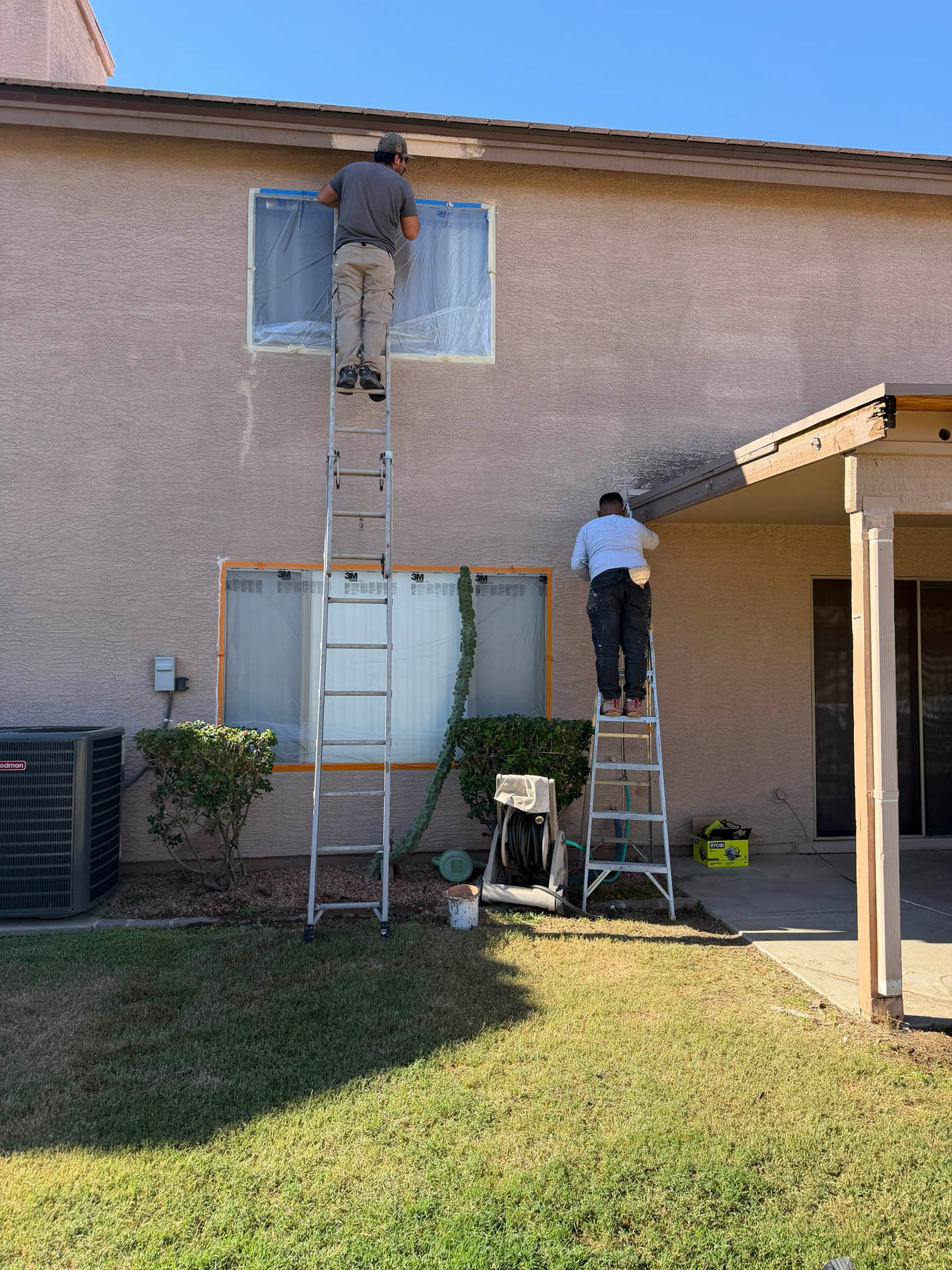
On a desert exterior, preparation accounts for a major portion of the work. A complete exterior repaint in Mesa should include the following steps.
- A full pressure wash to remove chalk, dust, and organic buildup. Painting over chalk can cause adhesion failure.
- Scraping and sanding all loose, blistered, or delaminating coating back to a sound edge.
- Patching stucco cracks and spalled areas with a compatible repair material, followed by texture matching so repairs do not telegraph through the finish.
- Re-caulking window and door perimeters, dissimilar material joints, hose bibs, light fixtures, and electrical penetrations. Caulk is a consumable material in this climate and is often one of the first components to fail.
- Priming bare stucco, repaired areas, and remaining chalky surfaces with an appropriate masonry conditioning primer.
- Thorough masking followed by two full coats applied at the manufacturer's specified spread rate.
Seasonal Application Planning
When to Paint in the East Valley
Paint manufacturers publish ambient and surface temperature ranges for application, and Arizona summer afternoons regularly exceed them. When a wall surface is too hot, the coating flashes off too quickly to level and bond properly. That can produce poor film formation, lap marks, and early blistering.
Follow the Shade
Summer work should begin on the west side in the morning and move toward the east side as shade shifts.
Monitor the Surface
Work should stop when wall temperatures exceed the coating manufacturer's stated application limit.
Protect the Cure Window
Avoid beginning immediately before a forecast monsoon event so the coating has time to cure before rain.
Late fall through early spring offers excellent exterior painting weather, which is why booking can tighten from November onward.
Hiring a Painting Company
What to Ask an Exterior Painting Contractor in Mesa
- Are you licensed, bonded, and insured in Arizona, and can you provide your ROC license number?
- What specific preparation steps are included in the written scope, including washing, crack repair, caulking, and priming?
- Which product and product line are you specifying, and why is it appropriate for this substrate and exposure?
- How many coats will be applied, and at what spread rate?
- How will you manage wall surface temperature during summer application?
- Will you match the existing stucco texture on repaired areas?
- If the property is in an HOA, will you help confirm the selected color against the approved palette before work begins?
A contractor who clearly answers these questions is describing a coating system. A contractor who only quotes a color and a price is describing a coat of paint.
Exterior Painting FAQs
Frequently Asked Questions
How often should you paint the exterior of a house in Mesa, AZ?
Most stucco homes in the East Valley need repainting every five to eight years with quality acrylic, and every eight to twelve years with a properly applied elastomeric system. Wood trim and fascia usually need attention sooner, often every three to five years. Dark colors and west-facing exposure shorten each of those ranges.
Why does my exterior paint feel like chalk?
That is UV photodegradation of the resin binder. The binder has broken down and is releasing pigment. It is one of the clearest signs that a wall has reached the end of its coating life. The residue must be removed before repainting because new paint will not properly bond to a chalky surface.
Can you paint a house in Arizona during the summer?
Yes, provided the crew works on the shaded side of the home and monitors surface temperature against the manufacturer's application limits. Applying paint to a wall that is above the product's maximum surface temperature can cause poor film formation and early failure. Scheduling around the sun is essential.
Is elastomeric coating always better for Arizona stucco?
Not always. It is excellent for bridging hairline cracks and adding film thickness on sun-beaten stucco, but its low permeability can make it a poor choice where moisture is trapped in or behind the wall. It should be selected after an inspection rather than used by default.
Does a darker exterior paint color really fail faster in Arizona?
Yes. Dark colors absorb more solar energy, run hotter, and cycle through wider daily temperature swings. They also tend to show fading more visibly because there is more contrast between the original and weathered color. This is one reason many East Valley HOA palettes favor lighter desert tones.
Will repainting fix cracks in my stucco?
Paint alone will not correct stucco cracks. Cracks should be repaired and textured before the finish coats are applied, or they can reappear through the new coating. On walls with widespread fine crazing, an elastomeric system applied after proper crack repair is a common approach.
Plan Before the Damage Spreads
Get Ahead of the Next Monsoon Season
UV damage is predictable, which means it can be managed. The homes in Mesa, Gilbert, Chandler, Tempe, Queen Creek, and Apache Junction that stay looking sharp are not using a secret product. They are repainting on a desert schedule instead of a national one, with thorough preparation behind the coating.
If your west wall is chalking, your trim is cracking, or you simply do not remember the last time the house was painted, a professional exterior inspection can help determine whether you need to repaint now or can safely plan the work for next season.
Desert Mesa Painting provides residential and commercial exterior painting, stucco preparation, and interior painting throughout Mesa and the greater Phoenix East Valley.
Serving Mesa, Gilbert, Chandler, Tempe, Queen Creek, Apache Junction, Scottsdale, and the greater Phoenix East Valley.
